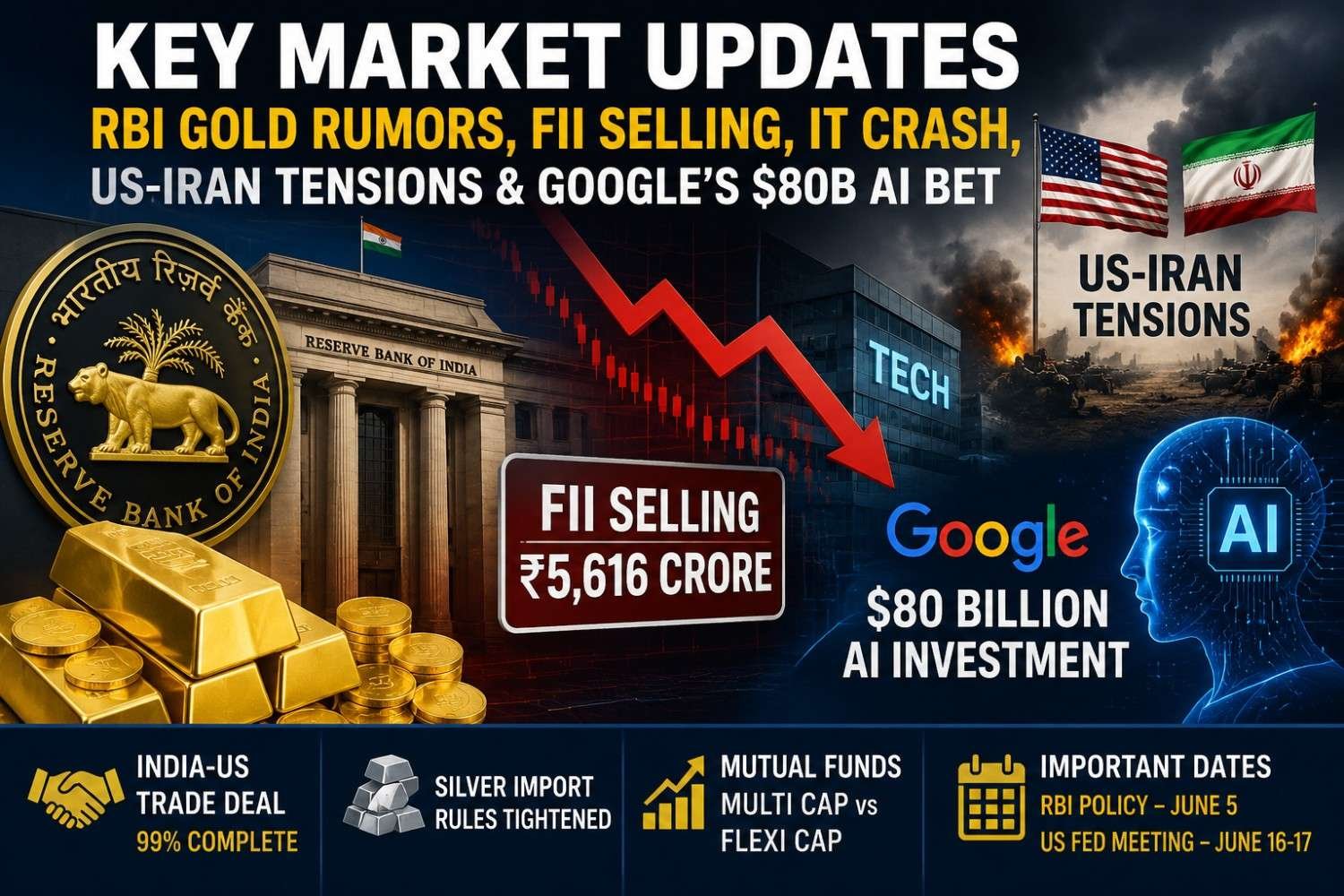
Indian stock markets witnessed another volatile trading session as investors reacted to multiple domestic and global developments. From rumors about RBI selling gold reserves to continuous FII selling, rising geopolitical tensions in the Middle East, and Google’s massive AI investment announcement, several factors influenced market sentiment.
As per our market analysis, understanding these developments is crucial for stock market investors, mutual fund investors, and gold investors looking to make informed decisions in the coming weeks.
RBI Clarifies Gold Sale Rumors: Has the Central Bank Sold Its Gold?
One of the biggest concerns among investors was a report suggesting that the Reserve Bank of India (RBI) had sold nearly $12 billion worth of gold to support the Indian Rupee.
The news quickly spread across social media platforms, creating fears that gold prices could decline significantly if India’s central bank was reducing its gold holdings.
However, both the RBI and the government’s PIB Fact Check unit denied the reports.
RBI’s Official Gold Reserve Position
According to RBI’s official data, India’s gold reserves remain largely unchanged.
The central bank clarified that its gold reserves continue to remain intact and no significant liquidation has taken place.
Why This Matters for Gold Investors
Central banks are among the largest buyers of gold globally. When central banks increase gold purchases, it is generally viewed as a positive signal for long-term gold demand.
On the other hand, large-scale gold sales by central banks can negatively impact market sentiment. RBI’s clarification has therefore helped calm investor concerns.
Why Did IT Stocks Fall Sharply?
The Indian IT sector faced considerable selling pressure after concerns emerged regarding the future impact of Artificial Intelligence on global technology services.
Global brokerage firms reportedly downgraded their outlook on consulting giant Accenture, citing:
- AI-driven business disruption
- Margin pressure
- Slower outsourcing growth
- Reduced earnings visibility
These concerns spilled over into Indian IT companies, including major technology stocks.
Although AI is expected to reshape the technology industry, many global CEOs continue to believe that AI will transform job roles rather than completely replace traditional IT services.
Government May Introduce Tax Changes to Attract FIIs
Foreign Institutional Investors (FIIs) have continued to sell Indian equities despite periodic market recoveries.
Market reports suggest that the Government of India is evaluating measures aimed at attracting foreign capital back into Indian financial markets.
Possible Measures Under Consideration
- Reduction in taxes on foreign bond investments
- Easier capital flow regulations
- Measures to stabilize the Indian Rupee
- Long-term investment incentives
During the latest trading session, FIIs reportedly sold approximately ₹5,616 crore worth of equities, highlighting continued foreign investor caution.
Trump’s Proposed 12.5% Tariff: What Does It Mean for India?
A new proposal in the United States could impose tariffs of up to 12.5% on imports connected to supply chains involving forced labor practices.
The proposal could potentially affect multiple countries, including India.
Key Highlights
- Proposal is currently under review.
- Public consultation is expected until July.
- Final implementation has not yet been confirmed.
- India is expected to engage with U.S. authorities to address concerns.
At present, investors should treat this as a developing policy issue rather than an immediate risk.
US-Iran Conflict Continues to Impact Global Markets
Geopolitical tensions in the Middle East remain elevated following military actions involving the United States and Iran.
Recent developments include:
- Attacks targeting military installations.
- Increased security concerns across the region.
- Rising uncertainty regarding energy supply routes.
- Continued diplomatic discussions regarding Iran’s nuclear program.
Impact on Financial Markets
The conflict has created concerns about:
- Higher crude oil prices
- Supply chain disruptions
- Inflationary pressures
- Increased volatility in global equity markets
Investors continue to monitor developments closely as further escalation could affect commodity prices worldwide.
India-US Trade Deal Reportedly Near Completion
A positive development for Indian markets is the progress being made on the India-US trade agreement.
According to reports, negotiations are approximately 99% complete, with only a few issues remaining unresolved.
Most of the pending discussions are believed to be related to agriculture and market access.
A finalized trade agreement could improve investor confidence and strengthen economic ties between both countries.
Google’s Massive $80 Billion AI Investment Signals New Technology Race
Google’s parent company, Alphabet, has announced plans to invest approximately $80 billion in Artificial Intelligence infrastructure and development.
The announcement has attracted significant attention from global investors.
Why This Investment Matters
- AI competition is accelerating globally.
- Technology spending is expected to increase substantially.
- New AI products and services may emerge rapidly.
- Indian IT companies may face greater competitive challenges.
Many analysts view this investment as a signal that the next phase of AI innovation is already underway.
Important Dates Investors Should Watch
Both events are expected to influence market sentiment, currency movements, bond yields, and equity valuations.
Government Tightens Silver Import Rules
The Government of India is introducing stricter regulations on silver imports.
Under the proposed framework:
- Silver with 99.9% purity in powder, grain, or similar forms will require authorization.
- Approval from the Directorate General of Foreign Trade (DGFT) may become mandatory.
- The move aims to improve import monitoring and strengthen regulatory oversight.
Mutual Fund Investors: Multi Cap vs Flexi Cap Funds
Many investors struggle to decide between Large Cap, Mid Cap, and Small Cap funds.
In such situations, Multi Cap and Flexi Cap funds often become attractive alternatives.
Multi Cap Fund Allocation Rules
- Minimum 25% in Large Cap stocks
- Minimum 25% in Mid Cap stocks
- Minimum 25% in Small Cap stocks
- Remaining allocation based on fund manager discretion
Flexi Cap Fund Allocation Rules
Fund managers have greater flexibility and can allocate investments across market capitalizations according to market conditions.
Important Metrics to Evaluate
Before investing, investors should analyze:
- Expense Ratio
- Alpha
- Beta
- Sharpe Ratio
- Standard Deviation
A strong mutual fund should not only deliver returns but also manage risk effectively.
Major Corporate Announcements
Several companies announced significant business developments.
Key Corporate Updates
| Company | Announcement |
|---|---|
| Budget Projects | Order worth ₹300–400 crore |
| Power Mech Projects | ₹266 crore contract |
| Capacity Infraprojects | ₹589 crore construction order |
| Alkem Laboratories | Launch of Semaglutide pre-filled syringes |
| John Cockerill | Order worth ₹1,250–1,300 crore |
| Borosil Renewables | Benefited from extension of import duties |
| Advait Energy | Won 150 MW Battery Energy Storage Project |
Market Outlook
The coming weeks could be crucial for Indian markets. Investors should closely monitor RBI policy decisions, FII flows, developments in the India-US trade agreement, crude oil prices, and ongoing geopolitical tensions.
While market sentiment has improved from recent lows, sustained upside momentum may depend on stronger foreign investment participation, policy support, and stability in global markets.
Please Follow the APNEWSHUB website for more updates
Please Follow the Our WhatsApp Channel Click here for More Updates