What is Shopify and how does it work (2025 Guide)
With a single, easy-to-use dashboard, Shopify is an e-commerce platform that assists small businesses in creating an online shop and selling products online. Shopify merchants may create a contemporary online store and sell via chat, email, text, and other channels, as well as on social networking platforms and seller marketplaces. With Shopify’s integrated point-of-sale (POS) for retail storefronts, pop-up shops, market sales, and more, in-person sales are also a breeze.
Shopify: What Is It?
Technically speaking, Shopify is a software-as-a-service (SaaS) sales platform that is built on subscriptions. Shopify allows consumers to sign up for a three-month subscription for INR 20 and choose from any Shopify plan that suits their needs, with annual subscription prices starting at INR 1,499 per month. A branded online store and a comprehensive set of online and in-person selling tools are supported by all standard subscriptions.
A comprehensive set of business management tools is provided by all plans. Every Shopify subscription includes features including product sourcing, tracking sales and inventory, processing payments, shipping, customer accounts, marketing, and reporting. Additionally, hundreds of Shopify Apps make it simple to add more tools to your toolkit. Check out our Shopify review to find out more.
How Does Shopify Operate?
Shopify functions by consolidating your customers, product information, and administrative duties into a single system that effortlessly integrates with all of your sales channels. Shopify makes it simple to investigate and grow into new product lines and sales channels once the fundamentals are in place.
This is a detailed explanation of how Shopify operates, from basic setup to sales management.
1. Register for a Free 14-Day Shopify Trial
Shopify offers a two-week risk-free trial period. Your credit card isn’t even requested up front by Shopify.
2. Link Your Channels of Sales
Your first sales channels are connected by the account creation wizard, but you are free to modify and add more at any time.
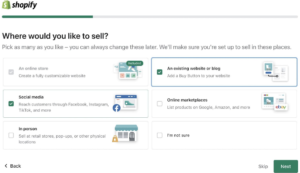
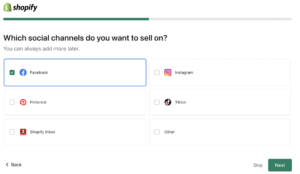
If you want to sell through your social media accounts, you can connect those in the setup wizard too. [What is Shopify]
3. Type in your product information or locate things to sell.
For things you manufacture or source yourself, provide item data, pricing, and photos. You can also use Shopify’s Handshake wholesale network and dropship merchants to locate products to sell.
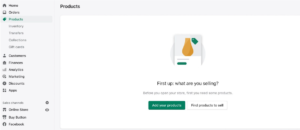
Be aware that in order to provide a well-rounded variety, many vendors pair their own products—whether they are manufactured or sourced—with complementary dropship items. Find out more about launching a dropshipping company.
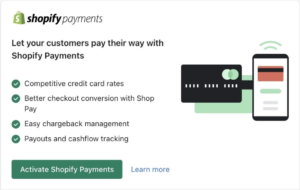
4. Configure Your Payments
You can link your own payment processor to your dashboard or instantly begin collecting payments by activating Shopify Payments with a single click. Over 100 external payment processors are supported by Shopify. Check out the top credit card processing firms for assistance in selecting the finest one.
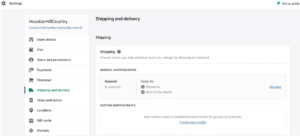
5. Configure taxes and shipping
Configure your shipping options, costs, and relevant sales tax details under the Settings tab.
As you develop your Shopify online store, you may begin selling right away. After completing Steps 1 through 5, you are prepared to sell utilizing the Buy Button tool, in-person with the POS card reader, and on multiple social media and marketplace platforms.
6. Create an Online Store on Shopify
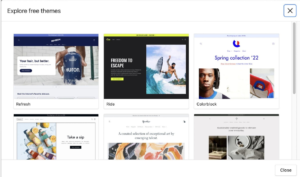
The next step is to set up your Shopify online store if you wish to sell through your own branded website. Once more, Shopify makes this simple by offering a variety of plug-and-play themes that just need little setup and additional content to be customized.
7. Handle, Ship, and Monitor Orders
Everything will be managed through your Shopify dashboard as orders come in. Setting up effective procedures for managing orders you ship yourself, dropship products, and even virtual goods like e-books and music downloads is simple with Shopify’s built-in features. Shopify automatically notifies your customers of purchase status and shipment tracking details. [What is Shopify]
You’re prepared to investigate Shopify’s sales-boosting services, such as email marketing, abandoned cart remarketing, and blogging, after you’ve finished the necessary setup and workflow.
How Much Will Shopify Cost in 2025?
In addition to monthly fees determined by your subscription plan, Shopify pricing also includes additional costs for advanced point-of-sale requirements, shipping labels, and payment processing.
Costs of a Shopify Subscription
In addition to offering data protection, Payment Card Industry (PCI) compliance, round-the-clock support, and a comprehensive suite of sales and company management tools, Shopify’s five online store options support an infinite number of products, orders, and customers.
Shopify also offers savings if you pay in advance—save 10% if you pay annually and 20% if you pay biennially.
Price
| Basic Shopify | Shopify | Advanced Shopify | Shopify Plus |
| INR 1,994 Per Month | INR 7,447 Per Month | INR 30,164 Per Month | INR 1,65,461 Per Month |
- The monthly rates for the Basic, Shopify, and Advanced Plans are INR 1,994, INR 7,447, and INR 30,164. Every Shopify online store subscription includes a comprehensive set of order, customer, and business management tools along with omnichannel sell-anywhere capabilities. You have access to more sophisticated marketing, administration, and reporting capabilities as well as greater shipping discounts and reduced payment processing fees as you advance through the plan tiers.
- Shopify Starter, which costs INR 20 per month, is a limited-featured plan that allows you to handle orders, fulfill orders, and check performance metrics to examine your sales and customer browsing patterns.
- Shopify Plus: Provides enterprise-level functionality designed for high-volume, multi-location, and multimillion dollar sellers (from INR 1,65,461 per month). At this level, plan pricing, terms, and features are negotiated according to business needs and sales volume.
Fees for Shopify Transactions and Payment Processing
You can either utilize Shopify’s built-in Payments feature or add your own payment processor. Shopify imposes a transaction fee to each online sale that ranges from 0.5% to 2% of the total price if you use your own payment processor. If you utilize Shopify Payments, this cost is waived.
As indicated in the above table, Shopify Payments provides flat-rate payment processing with rates determined by your membership plan. Using Shopify’s retail store POS system and mobile POS app, Shopify Payments also facilitates in-person sales.
Costs of Shipping on Shopify
You can utilize Shopify’s integrated shipping label printing feature on any plan if you ship orders. Discounts on USPS, UPS, DHL, and other carriers are competitive, and they get bigger on higher-tier plans.
Every time you process an order and print a shipping label, the shipping costs are calculated. When charges hit a certain threshold determined by your typical shipping volume, these expenses are applied to your card. However, shipping costs are added to your monthly Shopify bill if you only ship a small number of items each month.
High-end Shopify themes
Although Shopify offers merchants nine free shop templates, many choose to choose premium themes that offer greater customization possibilities, specialized styles, and other functionality. Over 100 premium themes are available in Shopify’s theme store.
Which Items Am I Able to Sell on Shopify?
Sales of almost any kind of product or service are supported by Shopify, including:
- Actual goods that you ship yourself
- Digital goods that may be downloaded, including music files, e-books, and digital gift cards
- Dropship products that are shipped straight from your vendors to clients
- Products and services offered for sale in a retail establishment
- Products and services sold in-person via mobile locations
- Services sold and managed through online booking
- Subscription boxes and memberships with automatic recurring payments
- Online courses, tutorials, workshops and webinars
- Tickets and passes for events, local tours and attractions
- Rentals sports equipment, formal wear, cameras and more
- Donations and fundraisers
Shopify does have a list of forbidden items, which includes, among other things, live animals, fireworks, explosives, guns, medical devices, and alcohol and tobacco. Shopify has the authority to terminate accounts that do not comply with its seller terms of service and will delete these kinds of things from a subscriber’s product pages.
Where Can I Use Shopify to Sell?
Shopify has a broad omnichannel sales reach. Some sales channels are integrated within the platform, including the POS, popular social media platforms, and the online store. Shopify Apps facilitate connections with other sales channels, like online courses, in-app purchases, and seller marketplaces. [What is Shopify]
Here is a sample of the several sales channels that Shopify allows you to access:
- Shopify online store: The best way to establish your brand and connect with customers online is using Shopify’s e-commerce-ready store.
- Social media platforms: Shopify integrates with Facebook, Instagram, Pinterest, WhatsApp, and TikTok to enable smooth sales through shoppable posts, videos, and pins.
- Marketplaces for sellers: To attract large marketplace audiences, list products on Amazon, Walmart, eBay, Etsy, and Lyst. Find out more about Amazon selling.
- In-person mobile sales: Local markets, food trucks, pop-up shops, and mobile services are all perfect for Shopify POS mobile card readers.
- Sales at retail stores: Shopify POS Pro facilitates checkout and shop management procedures for retail stores
- Websites and blogs that are not Shopify: You may incorporate Shop features into reviews, articles, and posts on other websites and blogs by using Shopify’s Buy Button embed.
- Mobile app with branding: Shopify’s Shop App delivers a branded in-app shopping experience with personalized product suggestions and deals after a purchase.
- Email and chat: You can send shoppable emails using Shopify’s Buy Button embeds, and you can turn chat sessions into sales chances with the Shopify Inbox app.
- Wholesale buyers: Small manufacturers and artists can connect with retail customers for wholesale deals through Shopify’s Handshake platform.
International marketplaces: To increase sales in foreign countries, Shopify integrates with apps like Shopify countries (global), Rakuten Ichiba (Japan), JD Marketplace (China), IndiaMart (India), and My Deal AU (Australia).
Shopify’s Benefits and Drawbacks
Although Shopify offers a wealth of business management tools and sales choices, is it the perfect choice for you? These Shopify benefits and drawbacks may help you make a decision.
Benefits of Shopify Use
- Overall usability: Novices may quickly set up a stunning Shopify store, several sales channels, and order processing procedures in the morning or afternoon and start making sales.
- Competitive monthly rates: Entry-level plans have low monthly fees, while higher-level plans have competitive prices.
- Safe technology: All technical aspects are taken care of for you by Shopify’s fully managed platform.
- Smooth retail, mobile, and in-person sales: You can sell in person anywhere with fully integrated retail store and mobile point-of-sale features.
- Integrated product sourcing: Use Shopify’s integrated dropship and wholesale networks to stock your store with minimal to no initial outlay of funds.
- Integrated email marketing: With a single click, automated email marketing and abandoned cart alerts can increase purchases.
- Unlimited growth potential: Some of the largest companies on the internet are housed on Shopify, which is prepared to handle both rapid and steady expansion. [What is Shopify]
Drawbacks of Shopify Use
- Cost: If you’re on a tight budget, you can find free and incredibly cheap Shopify alternatives.
- Transaction fees: Every time you make a purchase with a credit or debit card without using Shopify Payments, you are charged a transaction fee.
- Limitations of the theme: Shopify themes are typically quite simple, and expert code is needed to add more sophisticated features and functionality.
- Reduced possibilities for search engine optimization (SEO): Compared to platforms like WordPress, Shopify online businesses have more basic SEO tools.
- Simple blog tools: In comparison to WordPress, Squarespace, and Wix, Shopify offers relatively few blogging functionality.
The bottom line
In the realm of e-commerce platforms, Shopify is essentially unrivaled in terms of usability and smooth integration with sales channels. Shopify’s broad selling options and essential business management capabilities outweigh its minor shortcomings, which include rudimentary SEO tools, restricted store personalization, and simple blogging services. There isn’t a platform that compares to Shopify in terms of affordability, growth potential, sales reach, and ease of use for both power sellers and startups.
Featured Partners